

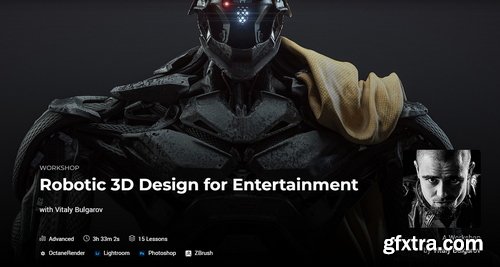
The Gnomon Workshop - Robotic 3D Design for Entertainment
https://www.thegnomonworkshop.com/workshops/robotic-3d-design-for-entertainment
Advanced, 3h 33m 2s, 15 Lessons, OctaneRender, Lightroom, Photoshop, ZBrush
- In this class Vitaly demonstrates and explains his approach and techniques for creating a solid “1st Pass” 3D Design of a robotic character for a Film or a Videogame project. The first pass design phase is considered one of the most challenging and critical stages of the 3D design creation process. “Challenging” because fast turnaround times with high quality are usually expected by clients at the beginning of a project when there is still room for exploration. Therefore, this stage demands an array of skills throughout several software packages and clarity of design thinking about the task at hand. “Critical” because a properly done and a successful 1st pass design creates a definite visual target for the project early on and lays the foundation for the future iterative work on the more refined/final design version. It also reduces overall cost and saves time of the asset production for the entire team while not compromising quality. Software and techniques explored by Vitaly include block-out sculpting in ZBrush, SubD modeling, retopo, CAD modeling in Moi3D, utilizing 3D KitBash libraries, Octane Render and Finalizing the image in Lightroom and Photoshop.
Vitaly Bulgarov introduces his comprehensive workshop, which demonstrates a professional workflow for entertainment industry robot design, combining traditional 3D modeling techniques with modern kitbashing approaches. Vitaly covers every stage from initial concept blocking through final image editing, providing viewers with a complete understanding of the character design pipeline. By the end, artists will understand how to create detailed, render-ready robotic characters with multiple material variations suitable for entertainment and concept art applications. This lesson focuses on the blocking stage, which involves creating a roadmap for design rather than the design itself, prioritizing gesture, structure, and the relationships among major forms. Vitaly demonstrates a professional production approach by making strategic decisions early about what elements deserve attention, using the right tools for specific tasks, and constantly evaluating whether design choices support the core concept. He teaches how to maintain discipline during blocking by resisting the temptation to detail prematurely while establishing a solid foundation that clearly communicates the design intent and guides subsequent iteration phases efficiently. The armor shell blocking stage is fundamentally about establishing a flexible foundation for detailed design work while maintaining creative freedom. By keeping the initial polygon count low and thinking strategically about shape relationships and negative space, artists can learn how to iterate quickly and make compositional changes easily. Vitaly's approach prioritizes understanding how parts relate to the whole design and balancing complex, detailed areas with simpler sections that allow visual breathing room. This is a principle borrowed from real-world industrial design, like sport bikes. This lesson demonstrates how efficient concept design for mechanical characters requires both technical CAD skills and design philosophy. Vitaly's approach to working in iterative passes while maintaining awareness of what will ultimately be visible prevents wasted effort on unnecessary details. By combining CAD precision with artistic judgment about structure, functionality, and visual appeal, designers can learn how to create convincing mechanical frameworks that serve as strong foundations for final character designs while remaining flexible enough to accommodate client feedback and design evolution. This lesson demonstrates that effective robotic character design requires balancing anatomical knowledge with creative interpretation. By intentionally reducing muscle count to show negative space, using consistent topology for pattern work, and differentiating materials early in the process, designers can learn how to create convincing cybernetic characters that read clearly as robots rather than armored humans. Vitaly's geometric, subdivision-based approach to muscle patterning maintains clean, production-ready meshes while achieving an organic, high-tech aesthetic suitable for a futuristic gladiator combat robot. This lesson emphasizes why successful hard-surface modeling requires balancing technical skill with design thinking and strategic workflow management. Vitaly's approach to working holistically across all components, while drawing inspiration from real-world industrial design, creates cohesive, functional-looking results. Most importantly, the lesson stresses how good modeling isn't just about technical execution but also about understanding the narrative context. His fighting robot's design serves entertainment purposes, making aesthetic choices that prioritize visual impact and storytelling over pure protection, much like real combat sports. This lesson emphasizes that successful robot design balances functional realism with creative fiction while maintaining visual clarity. Vitaly's approach prioritizes intelligent time management by focusing effort on high-impact areas like the head, which serves as the compositional anchor that influences how viewers perceive the entire design. By starting with simple forms, thinking three-dimensionally about lighting and material thickness, and deliberately avoiding overly literal or symmetrical designs, designers can learn how to create compelling robotic characters that read as machines rather than masked humans. In this lesson, Vitaly demonstrates an efficient approach to creating functional robotic hands by prioritizing form and function over premature detail work. By combining basic geometric modeling with strategic kitbashing and maintaining awareness of anatomical principles and animation requirements, designers can learn how to quickly produce convincing mechanical limbs suitable for initial design approval. His workflow exemplifies smart time management in production environments where not every element requires hero-level detail. This key lesson details why successful kitbashing requires strategic thinking rather than simply adding detail for its own sake. By limiting kitbash usage to non-primary areas, working methodically from large to small elements, and maintaining awareness of how lighting and materials will affect the final result, designers can significantly accelerate their workflow while preserving the unique character of their designs. Vitaly's balancing of high-tech and low-tech elements, combined with thoughtful placement and customization of pre-made assets, creates more interesting and believable mechanical designs than either pure kitbashing or purely original modeling alone. This lesson showcases a professional workflow for designing functional yet aesthetically striking sci-fi weaponry that tells a story through thoughtful details. Vitaly explains the importance of balancing historical weapon inspiration with futuristic industrial design elements, while using efficient modeling techniques like lofting and Boolean operations to rapidly iterate on designs. His emphasis on functional details (attachment points, weight considerations, and scale indicators) transforms basic 3D shapes into believable equipment for the character, demonstrating that good design considers both form and narrative function. This damage pass is a strategic enhancement rather than a mandatory step, used specifically when it supports the character's story and design aesthetic. For a melee combat character, adding selective battle damage to edges and prominent surfaces brings life and realism to the design without requiring extensive sculpting detail. Vitaly's approach is efficient, focusing effort where it will have the most visual impact while maintaining the overall design integrity. This lesson on render preparation emphasizes organization and optimization before moving to the rendering stage. By systematically splitting objects by material, decimating high-poly models, and conducting a final inspection, Vitaly teaches how to ensure a smooth transition into Octane render with manageable file sizes and proper material assignments. His methodical approach balances technical efficiency with the flexibility to make creative adjustments at the last moment. This lesson showcases Vitaly's iterative, problem-solving approach to rendering, where each pass addresses specific goals, from basic lighting setup to material refinement to final composition. His philosophy centers on studying real-world photography references, working methodically (one element at a time), and maintaining flexibility to explore creative opportunities that emerge during the rendering process. By establishing a solid foundation in modeling and structure, even unfinished angles can produce compelling imagery, demonstrating how thoughtful preparation multiplies creative possibilities in the final stages. Lightroom serves as a crucial step between 3D rendering and final output, allowing artists to refine their work with professional color-grading techniques. By studying cinematography and photography references while carefully balancing highlights and shadows, artists can learn how to develop a signature style that enhances their 3D renders. This final lesson emphasizes an efficient, iterative approach to finalizing 3D concept art that balances quality with time investment. Vitaly demonstrates that once the heavy lifting of 3D modeling is complete, the rendering and post-processing stages should be enjoyable and experimental, allowing artists to explore multiple material variations and angles to showcase their designs effectively. He explains the importance of knowing when subtle enhancements are sufficient versus when production-quality work (like Substance 3D Painter workflows) is necessary, ultimately helping artists deliver polished concept art without overworking details that won't significantly impact the final presentation.
robotic-3d-design-for-entertainment.part1.rar - 3.0 GB robotic-3d-design-for-entertainment.part2.rar - 2.6 GBIntroduction
Blockout
Hard Shells Base Pass
Frame Structure
Robotic Muscles
Hard Shells Second Pass
Head Details
Hands
Utilizing Kit Bash
Accessories
ZBrush Damage Pass
Model Prep for Render
Octane Rendering
Lightroom Image Editing
Photoshop + Alternative Rendering



126,000 Royalty-Free 3D Model
Udemy Türkçe


Top Rated News
- CreativeLive Tutorial Collections
- Fasttracktutorials Course
- Chaos Cosmos Library
- MRMockup - Mockup Bundle
- Finding North Photography
- Sean Archer
- John Gress Photography
- Motion Science
- AwTeaches
- Learn Squared
- PhotoWhoa
- Houdini-Course
- Photigy
- August Dering Photography
- StudioGuti
- Creatoom
- Creature Art Teacher
- Creator Foundry
- Patreon Collections
- Udemy - Turkce
- BigFilms
- Jerry Ghionis
- ACIDBITE
- BigMediumSmall
- Globe Plants
- Unleashed Education
- The School of Photography
- Visual Education
- LeartesStudios - Cosmos
- Fxphd
- All Veer Fancy Collection!
- All OJO Images
- All ZZVe Vectors
- CGTrader 1 CGTrader 2



















