

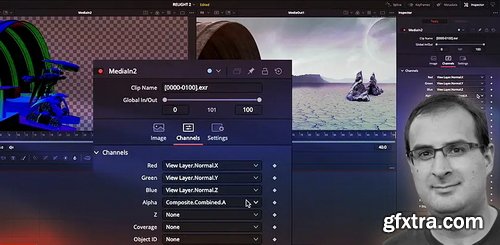
The big headline with the new Relight ResolveFX was obviously its machine learning capability. Like magic, Relight can extrapolate rough geometry from an image and use that geometry to drive relighting tools. In Part One – you learned how the Relight effect works, and how to optimize its use by separating the machine learning-based surface map generator from the relight matte generation. This allows you to get more real-time interactions while using this plugin. In this Insight – we take that separation a step further and input the Relight effect using existing geometry. You can do this if you: The above workflows can provide a normals pass. Normals give Relight the surface information it needs to work — bypassing the GPU-heavy machine learning analysis — and it will always have perfect accuracy compared to Relight’s surface estimations. By the end of this Insight, you should understand how to:
Part 2: Feeding external normal maps into the Relight ResolveFX
Key takeaways from this Insight



126,000 Royalty-Free 3D Model

Udemy Türkçe


Top Rated News
- CreativeLive Tutorial Collections
- Fasttracktutorials Course
- Chaos Cosmos Library
- MRMockup - Mockup Bundle
- Finding North Photography
- Sean Archer
- John Gress Photography
- Motion Science
- AwTeaches
- Learn Squared
- PhotoWhoa
- Houdini-Course
- Photigy
- August Dering Photography
- StudioGuti
- Creatoom
- Creature Art Teacher
- Creator Foundry
- Patreon Collections
- Udemy - Turkce
- BigFilms
- Jerry Ghionis
- ACIDBITE
- BigMediumSmall
- Globe Plants
- Unleashed Education
- The School of Photography
- Visual Education
- LeartesStudios - Cosmos
- Fxphd
- All Veer Fancy Collection!
- All OJO Images
- All ZZVe Vectors
- CGTrader 1 CGTrader 2



















