

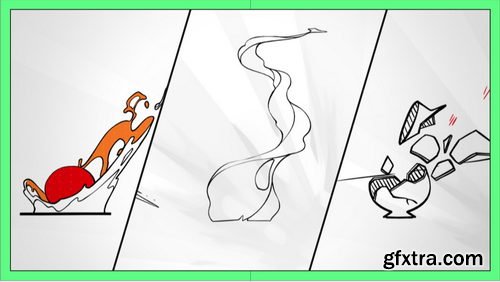
The BMS (Big, Medium, Small) technique is not just for defining positive shapes, but also negative ones! Try to design with variation, whether that is variation in your shapes, thickness, depth, line weight, or avoiding symmetry overall. The Wave Principle will help you design effects with good flow and motion. It's used to create a wide variety of FX. Think of a wave as an arc traveling up from an anchor point. Then control the speed by how many arcs you include before the wave reaches the end. Burst a collection of shapes to life with creation, and dissipate FX away. There are a variety of methods that can be used but at the introductory stage, focus on designing positive and negative shapes. Making looping effects look good is difficult. You can use keyframes to cycle FX forever. Plan your frames ahead of time to ensure you create a design that transitions well from your final frame back into the first. Learn the principles and techniques that will bring your fire FX to life. Fire's behavior relies on the scale of your effect. Small scale, like a candle flame, is a great use of the wave principle, while large scale, like a campfire, will rely on follow through. Realistic fluid effects are one of the most difficult VFX to create. Regardless of the type of water effect you are designing, it is important to keep in mind how water likes to break apart. The viscosity determines how liquids glob together and their overall speed. Create all kinds of amazing smoke and dust effects from a smoke bomb to the biggest duststorm. Smoke wisps behave more like fire, while billows act like clouds. Overlapping lines and shadows will help you define depth within your shapes. Think of smoke as overlapping shapes to help you define how light should interact with them. Make snappy dynamic lightning effects full of energy. One of the biggest mistakes when drawing lightning effects is designing it to travel across the screen. This actually results in slowing down the entire effect. Getting acquainted with different styles of flash frames will help you avoid this issue! Shatter objects into pieces! Debris is essentially a miscellaneous category, as it includes things like props and background elements, not just objects breaking into pieces. Get practice with drawing things in rotation, and using other elements as a base to create an effect from a prop.
Principles of FX Design
The Wave Principle
Creation & Dissipation
Cycles for Looping FX
Fire FX Foundations
Water & Liquid Foundations
Smoke & Dust Foundations
Lightning & Flash Frames
Debris FX Foundations



126,000 Royalty-Free 3D Model

Udemy Türkçe


Top Rated News
- CreativeLive Tutorial Collections
- Fasttracktutorials Course
- Chaos Cosmos Library
- MRMockup - Mockup Bundle
- Finding North Photography
- Sean Archer
- John Gress Photography
- Motion Science
- AwTeaches
- Learn Squared
- PhotoWhoa
- Houdini-Course
- Photigy
- August Dering Photography
- StudioGuti
- Creatoom
- Creature Art Teacher
- Creator Foundry
- Patreon Collections
- Udemy - Turkce
- BigFilms
- Jerry Ghionis
- ACIDBITE
- BigMediumSmall
- Globe Plants
- Unleashed Education
- The School of Photography
- Visual Education
- LeartesStudios - Cosmos
- Fxphd
- All Veer Fancy Collection!
- All OJO Images
- All ZZVe Vectors
- CGTrader 1 CGTrader 2



















