

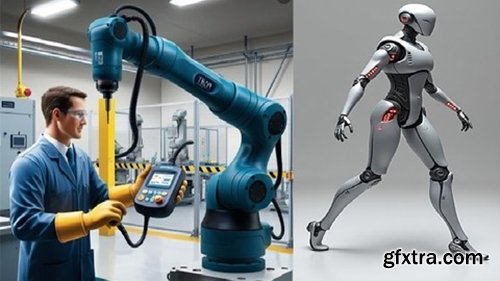
Language: English | Size: 3.61 GB | Duration: 7h 42m
https://www.udemy.com/course/robotics-fundamentals-and-kinematic-modeling-part-1/
Robot Kinematics, transformation matrices, DH Parameters,Robot configurations, Forward kinematics , frame assignments
What you'll learn Understand robot structure and components, including configurations, joints, actuators, end-effectors, and feedback systems. Model forward kinematics of robotic manipulators using classical and modified Denavit-Hartenberg (DH) conventions. Perform coordinate transformations using homogeneous transformation matrices and Euler angles for orientation analysis. Apply frame assignment algorithms to real-world manipulators (e.g., SCARA, Cartesian, Cylindrical) and calculate home positions accurately. Requirements All essential concepts are introduced from the ground up, making it suitable to learn everything you need to know Description This comprehensive course on Robotics: Fundamentals and Kinematic Modeling (Part 1) is designed to provide students with a thorough understanding of the basic principles and mathematical modeling techniques fundamental to robotic manipulators. The course begins by introducing the core concepts of robotics, distinguishing between robots and manipulators, and exploring various robot configurations to highlight the diversity in robotic system design. It covers the types of joints used in manipulators, differentiating between active and passive joints, and explains key terminologies that define a robot’s capabilities, limitations, and task suitability. Students also learn about essential components such as stepper and servo motors, along with their feedback devices, critical for robot motion control.The curriculum then shifts focus to end effectors, discussing different types of grippers and the basics of robot programming, which lay the groundwork for robot operation and task execution. A significant emphasis is placed on transformation and orientation, where students study the need for matrix transformations in robotic manipulators. Topics include Euler angles, their role and singularities, and homogeneous transformations vital for describing robot motion and positioning in space.A major highlight is the detailed study of Denavit-Hartenberg (DH) parameters, covering both classical and modified conventions that are primarily used in forward kinematics to represent the geometry of a robot manipulator. Students learn systematic algorithms for assigning coordinate frames and computing DH parameters, with hands-on examples involving SCARA, spherical, articulated, cylindrical, and Cartesian manipulators. This includes calculating home positions and transformation sequences that enable accurate spatial representation of robotic links and joints.By integrating theory with practical applications, this course equips learners with the essential skills to model robotic manipulators mathematically, understand their kinematic behavior, and prepare for more advanced topics such as robot dynamics, control, and motion planning. It is ideal for engineering students, researchers, and professionals aiming to build a strong foundation in robotics.
Robotics_Fundamentals_and_Kinematic_Modeling_Part_1.part1.rar - 3.4 GB Robotics_Fundamentals_and_Kinematic_Modeling_Part_1.part2.rar - 218.5 MB 


126,000 Royalty-Free 3D Model

Udemy Türkçe


Top Rated News
- CreativeLive Tutorial Collections
- Fasttracktutorials Course
- Chaos Cosmos Library
- MRMockup - Mockup Bundle
- Finding North Photography
- Sean Archer
- John Gress Photography
- Motion Science
- AwTeaches
- Learn Squared
- PhotoWhoa
- Houdini-Course
- Photigy
- August Dering Photography
- StudioGuti
- Creatoom
- Creature Art Teacher
- Creator Foundry
- Patreon Collections
- Udemy - Turkce
- BigFilms
- Jerry Ghionis
- ACIDBITE
- BigMediumSmall
- Globe Plants
- Unleashed Education
- The School of Photography
- Visual Education
- LeartesStudios - Cosmos
- Fxphd
- All Veer Fancy Collection!
- All OJO Images
- All ZZVe Vectors
- CGTrader 1 CGTrader 2



















