

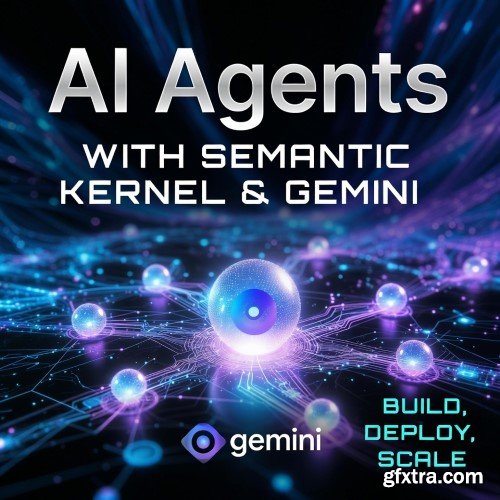
Master Basics of Semantic Kernel: Build Python AI Agents using Google Gemini, Custom Plugins, and Function Calling.
What you'll learn Requirements Description Who this course is for
Master the basics of Microsoft Semantic Kernel by integrating Google Gemini AI into Python applications for intelligent automation.
Build and deploy custom Python Plugins that allow AI models to interact with real-world data and external hardware simulations.
Implement advanced "Function Calling" using Semantic Kernel to let Gemini automatically decide when to trigger specific code logic.
Create a professional-grade CLI environment with color-coded logging to debug and monitor AI-to-plugin interactions in real-time.
Basic familiarity with Python programming (understanding functions and classes).
A computer with VS Code installed and a stable internet connection.
No prior experience with Semantic Kernel or LLM APIs is required; we will walk through getting your Gemini API key from scratch.
Unlock the power of "Agentic AI" by combining Microsoft’s Semantic Kernel with Google’s Gemini Flash model. Most AI tutorials stop at simple chatbots. This course takes you further. You will learn how to build a functional AI Smart Home Agent that doesn't just talk—it acts. Using Python, you will bridge the gap between Large Language Models (LLMs) and real-world logic.What makes this course unique? We focus on the Semantic Kernel (SK), a powerful SDK that allows you to integrate AI into your applications professionally. You will learn the industry-standard way to manage prompts, handle chat history, and, most importantly, create Custom Plugins.In this hands-on journey, we will cover:Environment Strategy: Setting up VS Code and securing your Gemini API keys.Professional Debugging: Implementing a color-coded logging system so you can see exactly how the AI "thinks" and which functions it triggers.Plugin Development: Writing Python code that the AI can execute to control devices (like our Smart Light simulation).Autonomous Function Calling: Configuring the kernel to automatically decide which tool to use based on the user's natural language.State Management: Using Chat History to ensure your agent remembers the context of the conversation.By the end of this course, you will have a working template for building AI agents that can be applied to customer support, data analysis, or IoT automation. Whether you are a developer or an AI enthusiast, these skills will put you at the forefront of the AI revolution.
This course is designed for Python developers and AI enthusiasts who want to move beyond simple chatbots. It is perfect for those looking to build "Agentic" workflows where an AI can actually do things—like controlling devices or querying databases—rather than just generating text. Whether you are a student or a professional developer, this course provides a clear, 5-step blueprint for building functional AI agents.


NeoSkola Bütün Kursları
Udemy Türkçe


Top Rated News
- TheBoudoirDivas All Tutorial
- 126,000 Royalty-Free 3D Models
- CreativeLive Tutorial Collections
- Fasttracktutorials Course
- Chaos Cosmos Library
- MRMockup - Mockup Bundle
- Finding North Photography
- Sean Archer
- John Gress Photography
- Motion Science
- AwTeaches
- Learn Squared
- PhotoWhoa
- Houdini-Course
- Photigy
- August Dering Photography
- StudioGuti
- Creatoom
- Creature Art Teacher
- Creator Foundry
- Patreon Collections
- Udemy - Turkce
- BigFilms
- Jerry Ghionis
- ACIDBITE
- BigMediumSmall
- Globe Plants
- Unleashed Education
- The School of Photography
- Visual Education
- LeartesStudios - Cosmos
- Fxphd
- All Veer Fancy Collection!
- All OJO Images
- All ZZVe Vectors
- CGTrader 1 CGTrader 2



















